 By Caleb Morgan
Updated November 2026
Parents, caregivers, and early childhood educators who search for best practice in infant toddler development usually want the same thing: a clear, evidence-informed guide to what children at this age need, and how adults can provide it day to day. This list focuses on book-length resources that translate research on relationships, play, language, and developmental milestones into practical routines. We selected titles based on the author’s professional background, the publisher’s reputation in early childhood education, the specificity of the guidance for children under three, and the consistency of themes with major professional frameworks. We did not test these books with children or in classrooms.
Best overall: Relationship-Based Care for Infants and Toddlers – View on Amazon
Best for group care settings: Authentic Relationships in Group Care for Infants and Toddlers – View on Amazon
Best for language and early literacy: Literacy Learning for Infants, Toddlers, and Preschoolers – View on Amazon
Best for program standards: Developmentally Appropriate Practice in Early Childhood Programs – View on Amazon
Best for hands-on caregiving: Being with Babies – View on Amazon
Our Top Picks
Quick Comparison
| Product | Best for | Key feature |
|---|---|---|
| Relationship-Based Care for Infants and Toddlers | Overall understanding of responsive care | Connects attachment research to daily practice |
| Authentic Relationships in Group Care for Infants and Toddlers | Group care settings | Applies RIE principles to classrooms and childcare |
| Literacy Learning for Infants, Toddlers, and Preschoolers | Language and early literacy | Focuses on practices that build early communication |
| Developmentally Appropriate Practice in Early Childhood Programs | Program-level standards | Covers birth through age 8 with a developmental framework |
| Being with Babies | Hands-on caregiving routines | Practical guidance on observing and responding to infants |
Relationship-Based Care for Infants and Toddlers: Fostering Early Learning and Development Through Responsive Practice

Relationship-Based Care for Infants and Toddlers: Fostering Early Learning and Development Through Responsive Practice (Early Childhood Education Series)
Best for: Adults who want a comprehensive, research-grounded foundation in responsive caregiving
This book suits parents who want to understand why responsive relationships matter so much in the first three years, and educators who need a framework for planning care around that idea. It is part of an early childhood education series, so it reads as a structured text rather than a quick tip collection.
Key specs:
- Format: paperback textbook-style edition
- Focus: birth to age 3, with emphasis on relationships and early learning
- Part of the Early Childhood Education Series
Pros:
- Connects attachment theory to specific daily routines
- Useful framework for reflecting on your own responses to children
- Well suited to coursework and professional development
Cons:
- Denser reading than a general parenting book
- Less focus on toddler behavior problems such as tantrums
Bottom line: Choose this if you want the theory behind responsive care and are willing to read a more academic text.
Authentic Relationships in Group Care for Infants and Toddlers: Resources for Infant Educarers (RIE) Principles into Practice

Authentic Relationships in Group Care for Infants and Toddlers – Resources for Infant Educarers (RIE) Principles into Practice
Best for: Group care settings
This title is aimed at teachers and caregivers working with several infants at once. It applies the principles associated with Resources for Infant Educarers to the realities of classrooms, staffing, and shared routines.
Key specs:
- Subject: RIE principles in group childcare
- Audience: infant and toddler caregivers, center directors
- Practice-oriented chapters on routines and observation
Pros:
- Addresses the specific challenges of group care
- Emphasizes slow, observant caregiving over constant stimulation
- Useful for staff training discussions
Cons:
- Assumes some familiarity with RIE terminology
- Less relevant for parents caring for one child at home
Bottom line: A strong choice for childcare teams who want to align daily practice with responsive, relationship-focused principles.
Literacy Learning for Infants, Toddlers, and Preschoolers: Key Practices for Educators

Literacy Learning for Infants, Toddlers, and Preschoolers: Key Practices for Educators
Best for: Language and early literacy
Language development is one of the most common concerns parents raise at the one- and two-year checkups. This book focuses on the practices adults can use to build vocabulary, conversation, and early reading readiness from infancy onward.
Key specs:
- Age range: infants through preschool
- Focus: key practices for educators supporting literacy
- Written for classroom and home settings
Pros:
- Clear focus on language-rich interactions
- Covers the earliest stages, not just preschool
- Practical strategies for reading and conversation
Cons:
- Narrower scope than a full development guide
- Some strategies are written for classroom groups
Bottom line: Pick this if your main question is how to support speech and early literacy across the first years.
Developmentally Appropriate Practice in Early Childhood Programs Serving Children from Birth Through Age 8, Fourth Edition
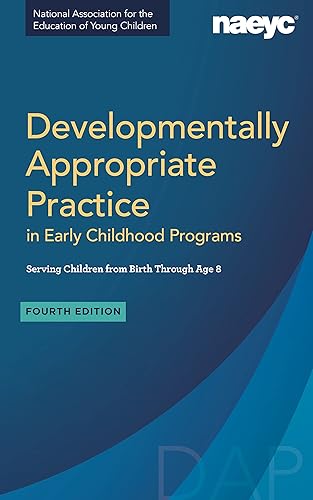
Developmentally Appropriate Practice in Early Childhood Programs Serving Children from Birth Through Age 8, Fourth Edition (Fully Revised and Updated)
Best for: Program-level standards
This widely cited text, produced by a major early childhood professional association, describes what developmentally appropriate practice means across the birth-to-8 span. It is often used as a reference for program quality and curriculum decisions.
Key specs:
- Age range: birth through age 8
- Fourth edition, fully revised and updated
- Organized around principles of child development and learning
Pros:
- Authoritative reference used across the field
- Covers the full early childhood span, useful for planning transitions
- Helpful for writing program philosophies and policies
Cons:
- Broad scope means infant content is only one part
- Reads more like a professional standards document than a parenting guide
Bottom line: Best for administrators and educators who need a reference point for program quality rather than daily caregiving tips.
Being with Babies: Understanding and Responding to the Infants in Your Care

Being with Babies: Understanding and Responding to the Infants in Your Care (Best Practices for Caregivers)
Best for: Hands-on caregiving routines
This book is written for people who spend hours each day with infants, whether as parents, nannies, or childcare workers. It emphasizes close observation and responding to cues, which many readers find more useful than rigid schedules.
Key specs:
- Focus: infant care and responsive observation
- Designed as a practical caregiver guide
- Accessible writing for non-specialist readers
Pros:
- Practical and easy to read in short sessions
- Encourages observation before intervention
- Useful for new caregivers building confidence
Cons:
- Less depth on toddler-age development after the first year
- Limited coverage of group care logistics
Bottom line: A good pick for parents and newer caregivers who want accessible, everyday guidance for the infant months.
Buying Guide
Match the Book to Your Role
Parents, family childcare providers, and center staff face different questions. A book written for classroom teams may feel impersonal at home, while a caregiver handbook may lack the program-level detail a director needs. Start by deciding whose daily practice you want to change.
Good picks for this: Being with Babies, Authentic Relationships in Group Care for Infants and Toddlers
Check the Age Range Carefully
Some titles cover birth to age 3, while others span birth through age 8. Broader books are useful for planning transitions, but infant-specific content may be a smaller share of the text. Look at the table of contents before buying.
Good picks for this: Relationship-Based Care for Infants and Toddlers, Developmentally Appropriate Practice in Early Childhood Programs
Consider the Level of Academic Detail
Some books read like textbooks, with citations and theory-heavy chapters. Others use plain language and concrete examples. Neither is better in general; the right level depends on whether you want background or quick application.
Good picks for this: Relationship-Based Care for Infants and Toddlers, Being with Babies
Look for Practical Strategies
Useful books describe what to do during routines such as feeding, diapering, and play, not just why development matters. Scan a chapter for specific examples, scripts, or observation prompts.
Good picks for this: Literacy Learning for Infants, Toddlers, and Preschoolers, Authentic Relationships in Group Care for Infants and Toddlers
Focus on Language Development
Speech and early literacy are frequent concerns in the second year. If that is your main question, pick a title with a clear language focus. For guidance on what to watch for, see When to Be Concerned About Toddler Speech Development: Red Flags by Age.
Good picks for this: Literacy Learning for Infants, Toddlers, and Preschoolers
Consider the Edition and Publication Date
Child development and early education guidance is updated periodically. Check the edition number, especially for professional standards texts that are revised every several years, and confirm the publisher is a recognized early childhood or education press.
Good picks for this: Developmentally Appropriate Practice in Early Childhood Programs
Use Books Alongside Professional Advice
No book replaces an individualized evaluation. If you have concerns about a child’s growth, hearing, speech, or behavior, a pediatrician or early intervention program can assess the child directly. Books work best as a framework for everyday decisions.
Good picks for this: Being with Babies, Relationship-Based Care for Infants and Toddlers
FAQ
What does “best practice” mean in infant and toddler development?
In early childhood, best practice generally refers to approaches that are developmentally appropriate, responsive to individual children, and supported by research on attachment, language, and play. It is less about a single method and more about consistent, attentive relationships and environments.
Are these books suitable for parents, or only for educators?
Some titles are written for parents and caregivers, such as Being with Babies. Others target educators and program leaders, such as the Developmentally Appropriate Practice text. Check the audience description before buying.
Do I need to read the books in order?
No. Each book stands on its own. Many readers start with one title that matches their immediate question, such as language or daily routines, and read others later.
How do these books relate to milestones?
Developmental milestones describe typical ages for skills like walking or first words. Best practice guidance focuses on how adults can support those skills. For a broader view of milestones, see Toddler Growth and Development Slideshare: 8 Milestones to Track (Ages 1–4).
Can these books help with toddler behavior and sleep?
Some touch on behavior through the lens of relationships and responsive care, but they are not specialized sleep or discipline guides. For bedtime concerns, see Toddler Won't Sleep in Crib? 5 Best Helpers for Bedtime (2026).
Should I rely on a book for a developmental concern?
No. If you are worried about a child’s development, talk with your pediatrician. In the United States, early intervention services for children under 3 are available through each state’s program, and a professional evaluation is the appropriate next step.
Conclusion
Each of these five books addresses best practice in infant toddler development from a different angle. Relationship-Based Care for Infants and Toddlers offers the broadest theoretical foundation. Authentic Relationships in Group Care suits childcare teams. Literacy Learning focuses on language and early reading. Developmentally Appropriate Practice serves program leaders who need a standards reference. Being with Babies is the most accessible choice for hands-on caregivers. Consider your role and the specific questions you have, then choose the title that matches them.
Sources
- Developmental milestones by age, including checklists for the first three years (cdc.gov)
- Research-based resources on infant and toddler social and emotional development
- Position statements and guidance on developmentally appropriate practice for young children
Related reading
About Caleb Morgan
Caleb Morgan is part of our editorial team and reviews and edits our toddler development & behavior guides, checking product details against manufacturer specifications and owner feedback.